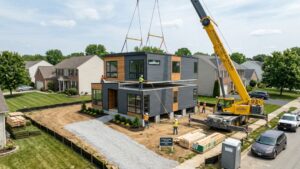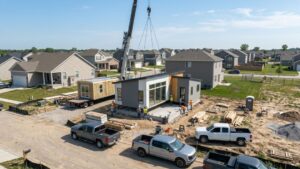
If you have been searching for honest numbers on 1 bed 1 bath modular home cost, this guide covers a clear breakdown of what to expect, what most quotes leave out, and how to build a realistic budget before you speak to a single builder.
For buyers also weighing how financing a modular home works, that question gets a lot easier once the full cost picture is clear.
How Much Does a 1 Bed 1 Bath Modular Home Cost?
The base unit for a compact 1-bedroom modular home runs $56,500 to $75,000 or more. The all-in installed cost, with everything needed to make the home livable on your land, typically falls between $90,000 and $160,000.
The gap between the model price and the finished project cost is where most buyers get caught off guard.
| Cost Category | Low Estimate | Mid Estimate | High Estimate | What It Usually Includes |
| Base unit price | $56,500 | $65,000 | $75,000+ | Structure, standard interior finishes |
| Foundation | $6,000 | $14,000 | $30,000 | Slab, crawl space, or basement |
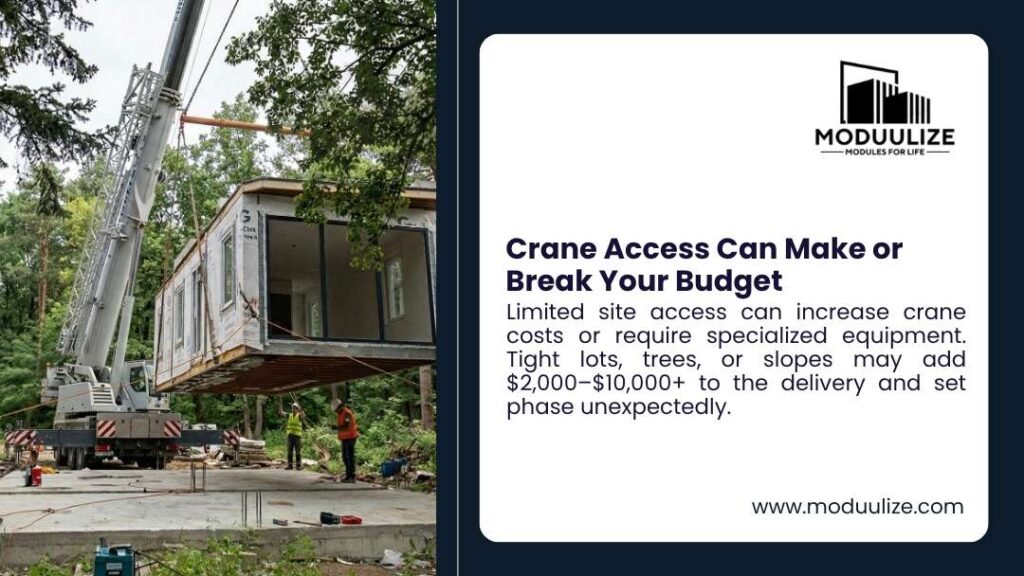
| Delivery and set | $5,000 | $9,000 | $14,000 | Transport, crane, module placement |
| Site prep and grading | $3,000 | $8,000 | $18,000 | Clearing, leveling, access road |
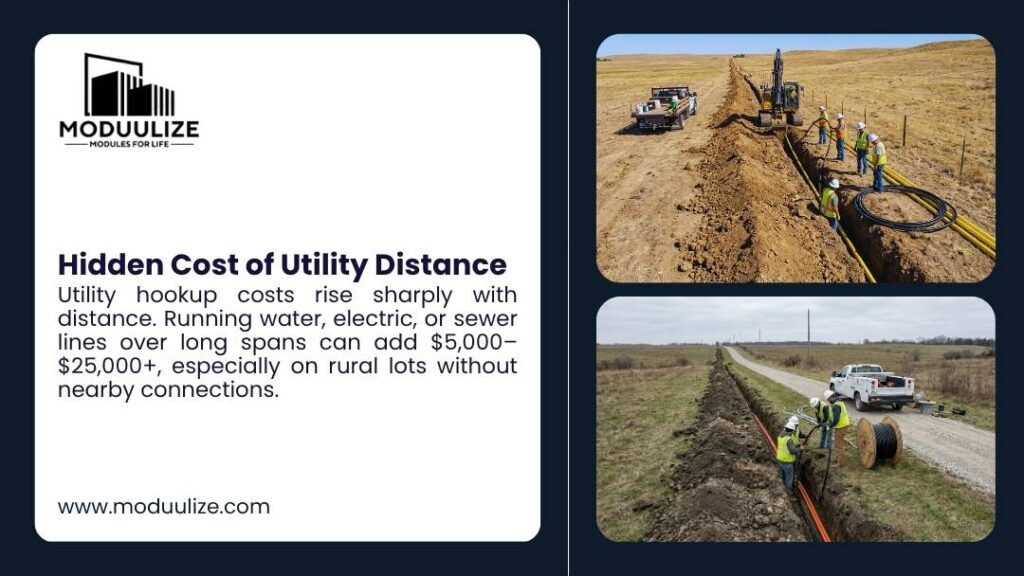
| Utilities and hookups | $5,000 | $12,000 | $30,000+ | Water, sewer/septic, electric, gas |
| Permits and fees | $1,500 | $4,000 | $10,000 | Local building approvals |
| Finishing work | $3,000 | $8,000 | $15,000 | Exterior trim, skirting, final details |
| Estimated total | ~$80,000 | ~$120,000 | ~$192,000+ | Full installed project |
Base Price Range for Small 1-Bedroom Modular Home Models
For instance, a 284 sq ft compact modular unit starts around $56,500, while a 432 sq ft 1 bed 1 bath model can run closer to $70,000. These figures reflect the factory-built structure with standard finishes.
Land, foundation, and site setup are priced separately.
The base price is what the manufacturer charges for the module. It is the starting point, not the finished cost.
All-In Installed 1 Bed 1 Bath Modular Home Cost Buyers Should Plan For
Most buyers in 2026 should budget $100,000 to $160,000 for a complete small modular home on a prepared lot. Raw land with no utility access can push the total well past $180,000 once every line item is counted.
The next section explains what drives those extra costs.
What Is Included in the Price, and What Costs Extra?
This is the most important section for anyone comparing builder quotes. Two contractors can quote the same model at very different prices because one includes site work and the other does not.
The base price from a manufacturer typically covers the modular structure, framing, roof, exterior sheathing, interior drywall, standard cabinetry, flooring, plumbing fixtures, electrical wiring, windows, and doors.
That is a complete module. It is not a move-in-ready home.
| Usually Included | Usually Not Included |
| Factory-built structure | Land purchase |
| Standard interior finishes | Foundation |
| Plumbing and electrical systems | Delivery and transport |
| Windows and exterior doors | Crane set and installation |
| Basic kitchen and bath fixtures | Site prep and grading |
| Roof system | Utility hookups (water, sewer, electric) |
| Standard insulation | Septic system or well |
| Permits and inspections | |
| Driveway or landscaping | |
| Deck or porch |
The Extra Costs That Change the Final Budget Fast
Foundation, delivery, and utility work are the three categories that catch buyers off guard most often.
According to NAHB cost data, foundation work alone ranges from roughly $6,000 for a basic slab to $30,000 or more for a full basement, depending on climate and local code requirements.
Transport and crane sets typically add $8,000 to $14,000 on top of that. If the land lacks water or sewer access, a well and septic system can cost $15,000 to $30,000 or more on their own.
None of those items appear in the base price.
The Biggest Factors That Change the Cost
Beyond the unit price, several variables can shift the total project budget by tens of thousands of dollars. Some are within your control. Others depend entirely on your land and local market.
Home Design, Finishes, and Customization Choices
Even within a small 1 bed 1 bath footprint, upgrades add up fast. Swapping standard laminate floors for luxury vinyl plank, selecting higher-grade cabinetry, or adding a kitchen island can each add $2,000 to $6,000 on top of the factory price.
Custom floor plan changes and energy-efficient upgrades carry additional costs beyond the base model. A good rule of thumb is to set aside 10 to 15 percent of the base unit cost for finishing upgrades if you plan to personalize the home.
| Cost Driver | Why It Matters | Low Impact | High Impact |
| Floor plan changes | Affects factory production time | Standard plan | Full custom layout |
| Interior finishes | Drives material and labor cost | Builder grade | Premium selections |
| Energy upgrades | Higher upfront, lower utility bills | Basic insulation | High-performance windows, HVAC |
| Exterior siding | Visual and weather protection | Standard vinyl | Fiber cement, mixed materials |
| Foundation type | Depends on climate and lot conditions | Slab | Full basement |
| Delivery distance | Longer haul, higher transport cost | Under 100 miles | 300+ miles |
| Utility readiness | Single biggest site cost variable | Connected lot | Raw land, full system install |
Land Condition, Permits, Utilities, and Site Prep
Land readiness is often the biggest swing factor in a modular home budget. A lot that already has water, sewer, and electric service at the road costs far less to build on than raw land where those systems must be installed from scratch.
Knowing how much it costs to prepare land for a modular home before you commit to a site can prevent serious budget problems.
Local permit fees and zoning rules also vary widely. Urban areas generally charge more than rural counties, and some municipalities add impact fees for new construction that buyers often miss until late in the process.
Delivery, Set, and Foundation Costs
The module leaves the factory on a truck and arrives at your site ready to set. Delivery covers more than shipping. Crane rental, the set crew, and module placement are all separate line items in most quotes.
Foundation work must also be complete before the home arrives. If the foundation is not ready on delivery day, delays can add rental and storage fees that were not part of the original budget.
Why Small Modular Homes Often Cost More Per Square Foot
A 1 bed 1 bath modular home can feel disproportionately expensive once all costs are included, and there is a straightforward reason for it.
Fixed Costs That Do Not Shrink With the Home Size
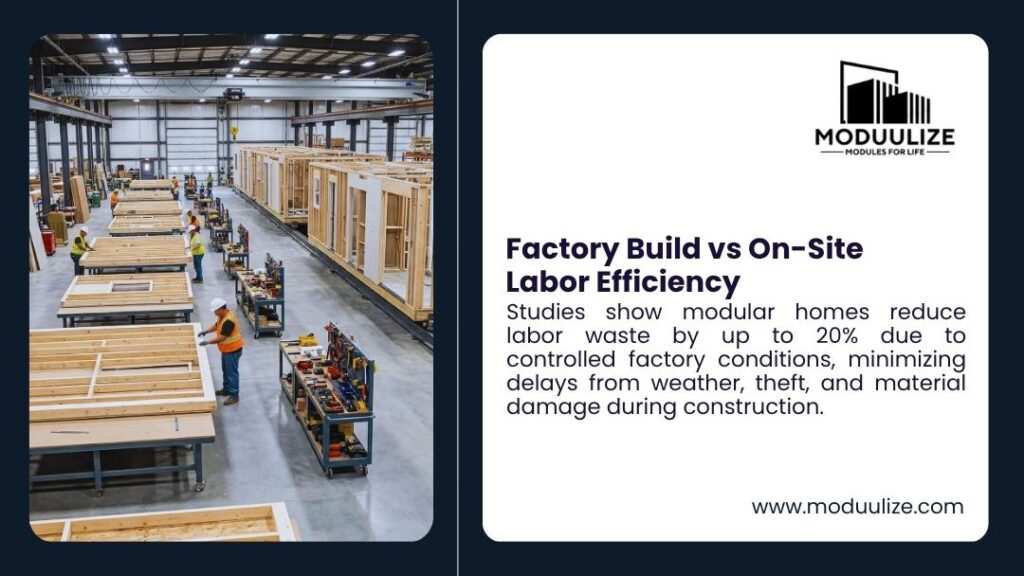
Permits cost roughly the same whether the home is 400 square feet or 1,400 square feet. The same applies to foundation work, crane rental, utility hookups, and site prep.
Those fixed costs get spread across fewer square feet in a smaller home, which drives the per-square-foot figure up considerably.
Cost analysis of modular construction supports this pattern, noting that smaller modular homes consistently show higher costs per square foot because setup and installation expenses do not scale down proportionally with size.
| Item | 1 Bed / 400 sq ft | 2 Bed / 900 sq ft | 3 Bed / 1,400 sq ft |
| Site prep | $8,000 | $9,500 | $11,000 |
| Foundation | $10,000 | $13,000 | $16,000 |
| Delivery and set | $9,000 | $10,500 | $12,000 |
| Permits | $3,500 | $4,000 | $4,500 |
| Fixed cost per sq ft | ~$76 | ~$41 | ~$31 |
Fixed setup costs alone can run $31 to $76 per square foot, depending on home size. That is before the unit itself is factored in.
Why a Bigger Home Can Sometimes Offer Better Value
A buyer who moves from a 1-bedroom to a 2-bedroom model may only spend $15,000 to $25,000 more on the unit itself, while those same fixed site costs stay nearly the same. That makes the larger home more economical on a total-cost-per-square-foot basis.
Buyers who are undecided between a 1-bed and a 2-bed layout should model out both full project budgets before committing. The numbers sometimes point clearly toward the larger home as the smarter financial choice, especially on raw land where site costs are already high.Our full breakdown of 2 bed 2 bath modular home cost covers what that step up actually looks like in terms of unit price, site costs, and total project budget.
Sample Budget Scenarios for a 1 Bed 1 Bath Modular Home
These three scenarios are planning estimates based on cost benchmarks. Real numbers vary based on location, land conditions, and builder pricing. Use them as starting points, not final quotes.
| Scenario | Home Price | Site and Setup Costs | Estimated Total | Best For |
| Scenario 1: Utility-ready lot | $62,000 | $28,000 | ~$90,000 | Buyers with a prepared lot, water and sewer at road |
| Scenario 2: Moderate site work | $65,000 | $48,000 | ~$113,000 | Suburban or semi-rural lot with some prep needed |
| Scenario 3: Raw land | $68,000 | $82,000+ | ~$150,000+ | Rural land with no utilities, well and septic required |
Scenario 1: Lower-Cost Project on Utility-Ready Land
Base unit: $62,000. Foundation, delivery, set, permits, and finishing: around $28,000. Total project: roughly $90,000.
This assumes the lot already has water, sewer or septic, and electric service at the road. It is the most favorable setup and the least common for buyers who are starting completely from scratch.
Scenario 2: Mid-Range Project With Moderate Site Work
Base unit: $65,000. Site work, foundation, utilities, delivery, and permits: around $48,000. Total project: roughly $113,000.
This reflects a more typical situation: a lot that needs grading, driveway work, and some utility connections but is not starting from zero.
Scenario 3: Higher-Cost Project on Raw Land
Base unit: $68,000. Full site prep, well, septic, utility connections, foundation, delivery, and permits: $82,000 or more. Total project: $150,000 and up.
Raw land with no existing utility infrastructure drives costs up fast. This scenario is common for rural buyers who place a home on inherited or family-owned land where nothing has been built before.
Modular vs Manufactured vs Tiny Home: Which Is Actually More Affordable?
These three categories get mixed together constantly, and the confusion leads buyers to compare products that are not actually comparable.
What Makes a Modular Home Different
A modular home is a permanent structure built to the same local and state building codes as a site-built home. Once placed on a foundation, it cannot be moved. It qualifies for conventional mortgage financing and is assessed and taxed like any other real property.
For buyers who want to dig deeper into this distinction, the full comparison between a manufactured vs modular home covers the code, financing, and resale differences in detail.
Where Manufactured and Tiny Homes May Cost Less
Manufactured homes (HUD-code homes) are built to federal standards rather than local building codes. They typically cost less than modular homes, sometimes significantly, but often carry different financing terms, depreciation patterns, and zoning restrictions.
Tiny homes under 400 square feet, particularly those built on wheels, can run $30,000 to $80,000 but face serious zoning barriers in many counties and are not legal permanent residences in most municipalities.
| Category | Typical Unit Price | Code Standard | Financing | Permanence |
| Modular home | $56,500 to $75,000+ | Local/state building code | Conventional mortgage eligible | Permanent, on foundation |
| Manufactured home | $40,000 to $100,000 | HUD federal standard | Chattel loan or FHA/Title I | Can be permanent or movable |
| Tiny home (on wheels) | $30,000 to $80,000 | Varies widely | Limited, personal loan typical | Not permanent in most areas |
Which Option Fits Which Buyer Best
Modular homes make the most sense for buyers who want permanent placement, conventional financing, and long-term resale value.
Manufactured homes suit buyers with tighter budgets who accept the trade-offs around code compliance and loan options.
Tiny homes work best as secondary structures, vacation properties, or short-term solutions where local zoning permits them.
Is a 1 Bed 1 Bath Modular Home Worth It for Your Situation?
For the right buyer, yes. For others, a different path may make more financial sense. Here is how to self-qualify before you go further.
Best-Fit Scenarios for This Type of Home
A 1 bed 1 bath modular home tends to work well when:
- You already own land with utility access in place
- You need a compact primary residence in a rural or semi-rural area
- You want a guest house or second dwelling on a property you own, where zoning allows
- You value faster construction over the timeline of a traditional build
- You want a permanent structure that holds value and qualifies for conventional financing
When comparing the full cost and quality picture, the decision between modular vs stick built often comes down to timeline and budget flexibility.
According to NAHB, modular construction typically completes in 3 to 5 months total, compared to 8 to 14 months for a comparable site-built home.
| Situation | Modular 1 Bed 1 Bath | Better Alternative |
| Own land with utility access | Strong fit | — |
| Raw land, no utilities | Possible, but expensive | Larger modular may offer better value per sq ft |
| Want tiny home price level | Not a fit | Tiny home or manufactured |
| Need conventional mortgage | Strong fit | — |
| Zoning minimum exceeds unit size | Not permitted | Check local requirements first |
| Guest house or ADU use | Good fit where allowed | — |
When Another Housing Option May Be Smarter
If your land requires a full utility install, well, septic, and extensive grading, the total project cost for a 1 bed 1 bath unit can approach the cost of a larger modular home with considerably more living space.
In those cases, a 2-bedroom model may give significantly more value for a modest increase in total spend. The fixed site costs stay nearly the same, but the usable square footage rises substantially.
7 Questions to Ask a Modular Builder Before You Request Quotes
Getting quotes without asking the right questions leads to budget surprises after contracts are signed. These seven questions protect you before you commit.
Questions About What the Quote Includes
- Does your quoted price include delivery and crane set?
- Is foundation work included, or is that a separate contractor?
- What interior finishes are standard, and what triggers an upgrade charge?
Questions About Site Work, Permits, and Installation
- Are permits and inspections included in your price?
- What site conditions could change the quote after I sign?
- Do you handle utility hookups, or do I need a separate contractor?
Questions About Upgrades and Future Price Changes
- Which upgrades raise the price fastest on a small unit?
| Question | Why It Matters |
| Is delivery included? | Transport alone can add $5,000 to $14,000 |
| Is foundation included? | Often a separate $6,000 to $30,000 expense |
| Are permits handled? | Missed permits cause delays and approval problems |
| What site conditions change the quote? | Protects against post-contract cost increases |
| Are utility hookups included? | Can be $5,000 to $30,000+ if not clearly stated |
| What are the fastest price drivers? | Helps avoid unplanned upgrade costs |
| What finishes are standard? | Clarifies what the base price actually delivers |
FAQs About 1 Bed 1 Bath Modular Home Cost
How much does a 1 bed 1 bath modular home cost in total?
The full project, including unit, foundation, delivery, site prep, utilities, and permits, typically runs $90,000 to $160,000. Raw land with no utility access can push that figure considerably higher.
What is usually included in a modular home base price?
The base price covers the factory-built structure with standard finishes, plumbing, electrical, windows, and doors. Foundation, delivery, site prep, permits, and utility hookups are almost always priced separately.
Why is a small modular home so expensive per square foot?
Fixed costs like permits, foundation, crane set, and utility work stay roughly the same regardless of home size. Spread across fewer square feet, those costs raise the per-square-foot figure considerably on compact homes.
Is a 1 bedroom modular home cheaper than a manufactured home?
In most cases, manufactured homes carry a lower base price. Modular homes meet local building codes, qualify for conventional financing, and tend to hold resale value more reliably. The right choice depends on your budget, land goals, and long-term plans.
How much do foundation, delivery, and setup add to the total cost?
Together, these three items typically add $20,000 to $55,000 on top of the base unit price, according to cost benchmarks. Foundation type, delivery distance, and site conditions all affect where the number lands.
Plan Your Modular Home Project With Confidence
Getting to an honest number on 1 bed 1 bath modular home cost is not complicated once you know what to ask. The base price is your starting point. Land readiness, foundation type, utilities, and delivery determine whether your project comes in at $90,000 or $160,000.
At Moduulize, we work across residential, commercial, and specialty modular solutions. That range of experience means our team has worked through the full variety of site conditions, budget scenarios, and project types that buyers encounter.
Our process is client-first: clear pricing, realistic timelines, and design options built around your actual needs. We focus on the full customer experience from the first conversation through final installation.
Whether you are placing a compact home on family land, adding a guest dwelling to an existing property, or evaluating a small modular build for development purposes, we give you a complete picture of your budget before you commit to anything. Request a free consultation with the Moduulize team today. We will walk through your site, your goals, and your numbers, and give you a clear plan you can build from.